phyBOARD-Nash i.MX93
phyBOARD-Nash i.MX93
Overview
The phyBOARD-Nash is based on the phyCORE-i.MX93 SoM is based on the NXP i.MX93 SoC. It features common industrial interfaces and can be used as a reference for development or in the final product. It is an entry-level development board, which helps developers to get familiar with the module before investing a large amount of resources in more specific designs.
i.MX93 MPU is composed of one cluster of 2x Cortex-A55 cores and a single Cortex-M33 core. Zephyr OS is ported to run on one of the Cortex-A55 core as well as the Cortex-M33 core.
Memory:
RAM: 512 MB - 2GB LPDDR4
EEPROM: 4 kB - 32 kB
eMMC: 8 GB - 256 GB
Interfaces:
Ethernet: 2x 10/100BASE-T (1x TSN Support)
USB: 2x 2.0 Host / OTG
Serial: 1x RS232 / RS485 Full Duplex / Half Duplex
CAN: 1x CAN FD
Digital I/O: via Expansion Connector
MMX/SD/SDIO: microSD slot
Display: LVDS(1x4 or 1x8), MIPI DSI(1x4), HDMI
Audio: SAI
Camera: 1x MIPI CSI-2 (phyCAM-M), 1x Parallel
Expansion Bus: I2C, SPI, SDIO, UART, USB
Debug:
JTAG 10-pin connector
USB-C for UART debug, 2x serial ports for A55 and M33
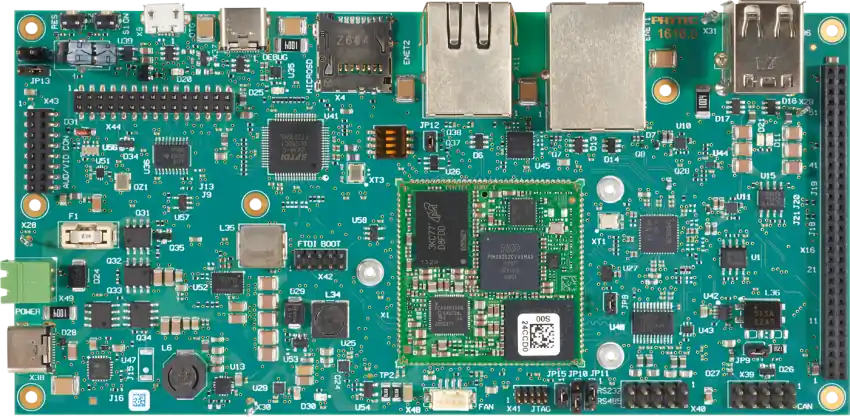
More information about the board can be found at the PHYTEC website.
Supported Features
The phyboard_nash board supports the hardware features listed below.
- on-chip / on-board
- Feature integrated in the SoC / present on the board.
- 2 / 2
-
Number of instances that are enabled / disabled.
Click on the label to see the first instance of this feature in the board/SoC DTS files. -
vnd,foo -
Compatible string for the Devicetree binding matching the feature.
Click on the link to view the binding documentation.
phyboard_nash/mimx9352/a55 target
On-target memory for this board target: 1 MiB of RAM, N/A of Flash.
Type |
Location |
Description |
Compatible |
|---|---|---|---|
CPU |
on-chip |
||
CAN |
on-chip |
NXP FlexCAN CANFD controller2 |
|
Clock control |
on-chip |
NXP i.MX9 fractional-N PLL1 |
|
on-chip |
i.MX CCM Rev2 (Clock Controller Module) IP node1 |
||
on-chip |
Generic fixed-rate clock provider4 |
||
Counter |
on-chip |
NXP Timer/PWM Module (TPM) used as timer6 |
|
DAI |
on-chip |
NXP Synchronous Audio Interface (SAI)1 |
|
Display |
on-chip |
NXP i.MX LCDIFV3 (LCD Interface v3) controller1 |
|
DMA |
on-chip |
NXP enhanced Direct Memory Access (eDMA)1 |
|
on-chip |
NXP MCUX EDMA controller1 |
||
Ethernet |
on-chip |
NXP ENET IP Module1 |
|
on-chip |
NXP ENET MAC/L2 Device1 |
||
on-chip |
NXP ENET MDIO Features1 |
||
on-chip |
NXP ENET PTP (Precision Time Protocol) Clock1 |
||
GPIO & Headers |
on-chip |
i.MX RGPIO4 |
|
I2C |
on-chip |
NXP LPI2C controller8 |
|
I2S |
on-chip |
NXP mcux SAI-I2S controller1 |
|
Interrupt controller |
on-chip |
ARM Generic Interrupt Controller v31 |
|
MIPI-DSI |
on-chip |
NXP MCUX MIPI DSI DWC1 |
|
Miscellaneous |
on-chip |
NXP MCUX i.MX93 MEDIAMIX Block Control1 |
|
on-chip |
NXP i.MX93 Video PLL controller1 |
||
Performance state |
on-chip |
NXP i.MX9 performance state (P-state) for the Cortex-A application cores3 |
|
Pin control |
on-chip |
This compatible binding should be applied to the device’s iomuxc DTS node1 |
|
on-chip |
The node has the ‘pinctrl’ node label set in MCUX SoC’s devicetree1 |
||
Power management CPU operations |
on-chip |
Power State Coordination Interface (PSCI) version 1.11 |
|
PWM |
on-chip |
MCUX Timer/PWM Module (TPM)6 |
|
SDHC |
on-chip |
NXP imx USDHC controller3 |
|
Serial controller |
on-chip |
||
SPI |
on-chip |
NXP FlexSPI controller1 |
|
on-chip |
NXP LPSPI controller8 |
||
Timer |
on-chip |
per-core ARM architected timer1 |
|
USB |
on-chip |
NXP EHCI USB device mode2 |
|
Watchdog |
on-chip |
NXP watchdog (WDOG32)2 |
phyboard_nash/mimx9352/m33 target
On-target memory for this board target: 124 KiB of RAM, 128 KiB of Flash.
Type |
Location |
Description |
Compatible |
|---|---|---|---|
CPU |
on-chip |
ARM Cortex-M33 CPU1 |
|
ADC |
on-chip |
NXP successive-approximation ADC (SAR ADC) controller1 |
|
ARM architecture |
on-chip |
i.MX ITCM (Instruction Tightly Coupled Memory)1 |
|
on-chip |
i.MX DTCM (Data Tightly Coupled Memory)1 |
||
Clock control |
on-chip |
i.MX CCM Rev2 (Clock Controller Module) IP node1 |
|
Counter |
on-chip |
NXP Low Power Periodic Interrupt Timer (LPIT)2 |
|
on-chip |
Child node for the Low Power Periodic Interrupt Timer node, intended for an individual timer channel8 |
||
on-chip |
NXP Time Stamp Timer (TSTMR)2 |
||
Display |
on-chip |
NXP i.MX LCDIFV3 (LCD Interface v3) controller1 |
|
GPIO & Headers |
on-chip |
i.MX RGPIO4 |
|
I2C |
on-chip |
NXP LPI2C controller8 |
|
Interrupt controller |
on-chip |
ARMv8-M NVIC (Nested Vectored Interrupt Controller)1 |
|
Mailbox |
on-chip |
NXP i.MX Message Unit as Zephyr MBOX1 |
|
MIPI-DSI |
on-chip |
NXP MCUX MIPI DSI DWC1 |
|
Miscellaneous |
on-chip |
NXP MCUX i.MX93 MEDIAMIX Block Control1 |
|
on-chip |
NXP i.MX93 Video PLL controller1 |
||
MMU / MPU |
on-chip |
ARMv8-M MPU (Memory Protection Unit)1 |
|
Pin control |
on-chip |
This compatible binding should be applied to the device’s iomuxc DTS node1 |
|
on-chip |
The node has the ‘pinctrl’ node label set in MCUX SoC’s devicetree1 |
||
PWM |
on-chip |
MCUX Timer/PWM Module (TPM)6 |
|
Serial controller |
on-chip |
NXP LPUART1 |
|
SPI |
on-chip |
NXP LPSPI controller8 |
|
Timer |
on-chip |
ARMv8-M System Tick1 |
Devices
System Clock
This board configuration uses a system clock frequency of 24 MHz. Cortex-A55 Core runs up to 1.7 GHz. Cortex-M33 Core runs up to 200MHz in which SYSTICK runs on same frequency.
Serial Port
This board configuration uses a single serial communication channel with the CPU’s UART2 for A55 core and M33 core. The u-boot bootloader or Linux use the second serial port for debug output.
Programming and Debugging (A55)
Copy the compiled zephyr.bin to the BOOT partition of the SD card and
plug the SD card into the board. Power it up and stop the u-boot execution at
prompt.
Use U-Boot to load and execute zephyr.bin on Cortex-A55 Core0:
fatload mmc 1:1 0xd0000000 zephyr.bin; dcache flush; icache flush; dcache off; icache off; go 0xd0000000
Use this configuration to run basic Zephyr applications and kernel tests, for example:
# From the root of the zephyr repository
west build -b phyboard_nash/mimx9352/a55 samples/hello_world
Use this configuration to run basic Zephyr applications, for example:
*** Booting Zephyr OS build v3.7.0-848-gb4d99b124c6d ***
Hello World! phyboard_nash/mimx9352/a55
Programming and Debugging (M33)
Copy the compiled zephyr.bin to the BOOT partition of the SD card and
plug the SD card into the board. Power it up and stop the u-boot execution at
prompt.
Use U-Boot to load and kick zephyr.bin to Cortex-M33 Core:
load mmc 1:1 0x80000000 zephyr.bin;cp.b 0x80000000 0x201e0000 0x30000;bootaux 0x1ffe0000 0
Use this configuration to run basic Zephyr applications, for example:
# From the root of the zephyr repository
west build -b phyboard_nash/mimx9352/m33 samples/hello_world
This will build an image with the synchronization sample app, boot it and display the following console output:
*** Booting Zephyr OS build v3.7.0-848-gb4d99b124c6d ***
Hello World! phyboard_nash/mimx9352/m33
Starting the M33-Core from U-Boot and Linux
Loading binaries and starting the M33-Core is supported from Linux via remoteproc. Please check the phyCORE-i.MX93 BSP Manual for more information.
References
For more information refer to the PHYTEC website.